
[ez-toc]
When choosing a security patrol service, property owners and managers often face a simple question: Should we use security foot patrols, night patrols, or both?
The answer depends on more than the time of day.
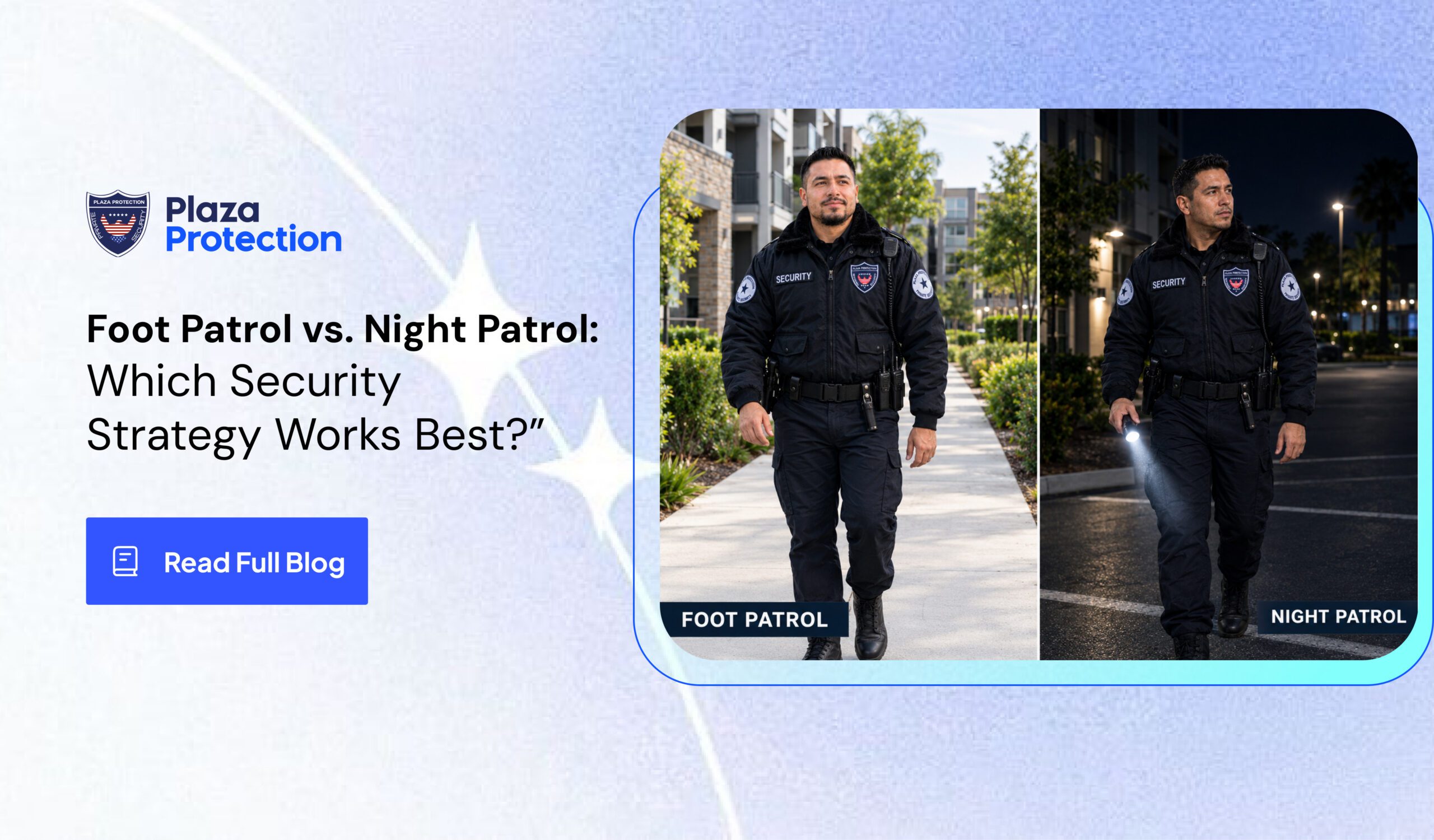
Foot patrols and night patrols serve different security purposes. A foot patrol puts a security officer directly inside the property environment, allowing them to inspect entrances, walkways, parking structures, buildings, and other areas that require close observation. Night patrols focus on protecting properties during after-hours periods, often using mobile or vehicle patrols to cover larger areas when fewer employees, tenants, customers, or visitors are present.
For many properties, the best approach is not choosing one over the other. It is creating a patrol strategy that combines the right type of coverage, timing, routes, and reporting based on the property’s actual risks.
Quick Answer: Foot Patrol vs. Night Patrol
Security foot patrols are best when you need close, visible monitoring of specific areas and regular interaction with people on the property.
Night patrols are best when security risks increase after business hours and you need broader coverage of a property during evenings, overnight hours, weekends, or other low-occupancy periods.
| Factor | Security Foot Patrol | Night Patrol |
|---|---|---|
| Primary purpose | Close-range property monitoring | After-hours security coverage |
| Typical timing | Day or night | Primarily evening/overnight |
| Coverage | Specific areas and routes | Larger areas or multiple zones |
| Officer movement | On foot | Often vehicle/mobile, sometimes on foot |
| Visibility | Very high at ground level | High, especially with marked patrol vehicles |
| Best for | Entrances, common areas, parking structures, retail, residential communities | Construction sites, warehouses, commercial properties, large parking areas |
| Human interaction | High | Depends on patrol model |
| Large-property coverage | More limited | Stronger with mobile patrols |
| After-hours protection | Possible | Primary purpose |
| Best strategy | Targeted, close observation | Broad, flexible after-hours coverage |
The right choice ultimately depends on where your vulnerabilities are, when they occur, and how much property needs to be covered.
What Is a Security Foot Patrol?
A security foot patrol is a security service in which a trained security officer physically walks through designated areas of a property to identify security concerns, safety hazards, suspicious activity, unauthorized access, and other issues.
Unlike a stationary guard who remains at one post, a foot patrol officer moves throughout the property.
This allows the officer to inspect areas that may not be visible from a security desk, gate, or vehicle.
A foot patrol may include:
- Building entrances and exits
- Parking lots
- Parking garages
- Hallways and corridors
- Common areas
- Stairwells
- Walkways
- Loading areas
- Perimeters
- Restricted areas
- Tenant areas
- Retail spaces
- Residential common areas
- Construction areas
The exact patrol route should be based on the property’s layout, operating environment, known vulnerabilities, and security objectives.
Why Are Security Foot Patrols Effective?
One of the biggest advantages of foot patrols is proximity.
A security officer walking through a property can observe conditions at ground level that may be difficult to identify remotely.
An officer may notice:
- An unsecured door
- A broken lock
- Suspicious activity
- A damaged fence
- A blocked walkway
- Poor lighting
- An unattended package
- Signs of vandalism
- Unauthorized individuals
- Vehicle-related concerns
- Safety hazards
- Unusual sounds or activity
Foot patrol officers can also interact directly with employees, tenants, customers, residents, and visitors.
That human interaction can be particularly valuable in environments where security officers are expected to provide both protection and assistance.
What Is Night Patrol Security?
Night patrol security refers to security coverage specifically designed around the risks that occur during evening and overnight hours.
When businesses close and employees leave, properties often experience a significant change in activity.
Parking areas become emptier. Offices become unoccupied. Loading areas become quieter. Fewer employees are available to notice unusual activity.
That can create opportunities for:
- Trespassing
- Burglary
- Theft
- Vandalism
- Unauthorized access
- Property damage
- Loitering
- Vehicle break-ins
- Illegal dumping
- After-hours activity
Night patrols help maintain an active security presence during these periods.
Depending on the property, a night patrol can involve:
- Vehicle patrols
- Foot patrols
- Perimeter inspections
- Building checks
- Lock and door checks
- Parking lot inspections
- Alarm response
- Access-point checks
- Incident response
- Security reporting
- Communication with property management
Mobile or vehicle patrols are particularly useful when a property covers a large area because an officer can move between multiple zones more efficiently than an officer restricted to walking.
Foot Patrol vs. Night Patrol: The Biggest Difference
The biggest misconception is that foot patrol and night patrol are competing types of security services.
They actually describe two different characteristics of a patrol.
Foot patrol describes how the officer moves through the property.
Night patrol describes when the security coverage takes place.
That means you can have:
- Daytime foot patrols
- Nighttime foot patrols
- Daytime vehicle patrols
- Nighttime vehicle patrols
- Day-and-night patrol coverage
- A combination of foot and vehicle patrols
This distinction is important when designing a security plan.
For example, a shopping center might use foot patrols during busy operating hours when customers and tenants need a visible security presence, then transition to vehicle patrols after closing.
A construction site might require vehicle patrols overnight because the site is large and largely unoccupied.
A residential community might benefit from both foot patrols and vehicle patrols depending on the size and layout of the property.
7 Key Advantages of Security Foot Patrols
1. High Visibility
A uniformed officer walking through a property creates an obvious security presence.
Visibility can discourage unwanted behavior because individuals know that someone is actively monitoring the environment.
This is particularly useful in:
- Shopping centers
- Apartment communities
- Office buildings
- Retail properties
- Parking structures
- Mixed-use developments
- Public-facing commercial properties
The officer is not simply watching from a distance. They are physically moving through the areas where people are present.
2. Better Ground-Level Observation
Foot patrol allows officers to see and hear their surroundings at close range.
This can help identify conditions that might otherwise go unnoticed.
For example, an officer may discover a damaged door, broken lighting, suspicious activity, or an unsecured access point while completing a routine patrol.
3. Stronger Interaction With People
A foot patrol officer is generally more approachable than an officer passing through a property in a vehicle.
Employees, residents, customers, and visitors can communicate concerns directly.
That makes foot patrol particularly useful in properties where customer service and community interaction are important.
4. Access to Areas Vehicles Cannot Reach
Vehicles cannot enter every part of a property.
Foot patrol officers can inspect:
- Interior hallways
- Stairwells
- Building entrances
- Pedestrian walkways
- Parking structures
- Tenant areas
- Restricted corridors
- Smaller access points
5. Detailed Property Familiarity
Regular foot patrols allow officers to become familiar with the normal conditions of a property.
That familiarity matters.
When officers know what a property normally looks and sounds like, unusual conditions may become easier to identify.
6. Immediate Presence During Incidents
If an incident occurs near the officer’s patrol area, the officer may be able to investigate or respond quickly according to the site’s post orders and emergency procedures.
7. Support for Customer and Tenant Experience
Security officers often become an important point of contact for people on a property.
They may assist with directions, report maintenance concerns, help during emergencies, or provide an escort when appropriate.
That means foot patrol can contribute to both security and the overall experience of the property.
7 Key Advantages of Night Patrol Security
1. Protects Properties During Low-Occupancy Hours
One of the biggest advantages of night patrols is maintaining security coverage when fewer people are around.
This can be especially important for:
- Warehouses
- Construction sites
- Office buildings
- Commercial properties
- Industrial facilities
- Parking lots
- Apartment communities
- Vacant properties
2. Covers Large Areas Efficiently
Vehicle-based night patrols can cover substantially more ground than an officer walking a large property.
An officer can inspect multiple areas during a patrol cycle and respond to concerns across the property.
3. Provides After-Hours Deterrence
A marked security vehicle or visible security officer can make it clear that the property is being actively monitored.
The unpredictability of patrol timing can further strengthen deterrence.
4. Identifies Overnight Security Problems
Night patrol officers can check for issues such as:
- Open doors
- Broken windows
- Damaged fencing
- Suspicious vehicles
- Unauthorized people
- Property damage
- Lighting problems
- Unusual activity
5. Supports Alarm Response
Depending on the security plan and authority provided to the security team, patrol officers can respond to alarms or reported concerns and investigate the surrounding area.
6. Reduces the Need for Full-Time Coverage Everywhere
Large properties may not need a dedicated officer standing at every location throughout the night.
A properly designed mobile patrol can provide coverage across multiple areas.
This can make patrol-based security a practical option for properties where a permanent guard post at every location is unnecessary.
7. Provides Documented After-Hours Visibility
Modern patrol programs can use digital reporting, GPS verification, timestamps, photographs, and incident reports to provide property managers with greater visibility into what happened during overnight coverage.
Foot Patrol vs. Night Patrol: Which Is Better for Your Property?
There is no universal winner.
The better solution depends on your property’s size, layout, operating hours, risk profile, occupancy, previous incidents, and security objectives.
Foot patrol may be better when:
- People are actively using the property
- You need a visible security presence
- The property contains interior areas
- Customer interaction matters
- Parking structures need regular inspection
- Entrances and common areas require close monitoring
- The property is relatively compact
- You need an approachable security presence
Night patrol may be better when:
- Security risks increase after closing
- The property becomes largely unoccupied
- The site is large
- Parking areas require overnight monitoring
- There are multiple buildings or zones
- Construction equipment or materials are left overnight
- Unauthorized access is an after-hours concern
- You need mobile coverage across a large property
A combination may be best when:
- The property operates throughout the day and night
- Different risks exist during different hours
- You have both interior and exterior security concerns
- The property is large
- Customer-facing areas need foot patrols
- Perimeters and parking areas need mobile patrols
When Should You Combine Foot Patrols and Night Patrols?
For many commercial properties, combining patrol methods creates a stronger security strategy.
Consider a shopping center.
During business hours, customers are walking between stores, employees are entering and leaving, deliveries are arriving, and parking areas are active.
A foot patrol officer can provide visible protection and interact with people throughout the property.
After closing, the environment changes.
The property becomes quieter. Most stores are closed. Parking areas become less occupied. Unauthorized activity becomes easier to overlook.
At that point, mobile or vehicle patrols may become more efficient.
A security plan could therefore look like:
Daytime → Foot patrol
- Store entrances
- Common areas
- Parking structures
- Customer areas
- Tenant spaces
Evening → Combination
- Foot patrol around active areas
- Vehicle patrol around the perimeter
Overnight → Mobile patrol
- Parking areas
- Building exteriors
- Loading zones
- Access points
- Perimeter
This is an example of risk-based security planning rather than using the same patrol method 24 hours a day.
Which Properties Benefit From Foot Patrols?
Foot patrols are especially useful where security officers need to be visible and accessible.
Shopping Centers
Foot patrol officers can monitor entrances, walkways, common areas, parking structures, and high-traffic locations.
They can also assist customers and communicate with tenants.
Residential Communities
Apartment complexes, HOAs, and other residential communities can use foot patrols to monitor common areas, entrances, parking facilities, and community spaces.
Office Buildings
Foot patrols can supplement access control and security systems by checking entrances, common areas, stairwells, and other locations.
Healthcare Facilities
Healthcare properties can have complex security needs involving patients, visitors, employees, restricted areas, and emergency situations.
Foot patrols can provide a visible and accessible security presence.
Retail Properties
Retail environments benefit from officers who can move through customer-facing areas while watching for suspicious behavior and security concerns.
Which Properties Benefit From Night Patrols?
Night patrols are particularly useful when large areas need protection during low-occupancy periods.
Construction Sites
Construction sites can contain expensive equipment, tools, materials, temporary structures, and unfinished buildings.
After workers leave, mobile patrols can monitor the perimeter, access points, equipment areas, and other vulnerable locations.
Warehouses
Warehouses often have large footprints, loading areas, multiple doors, parking areas, and valuable inventory.
Overnight patrols can provide additional visibility when staffing is reduced.
Commercial Properties
Office and commercial buildings can become significantly quieter after employees leave.
Night patrols can focus on entrances, parking areas, building exteriors, and other vulnerable locations.
Parking Facilities
Parking garages and lots may require additional attention during evening and overnight hours when fewer people are present.
Vacant Properties
Vacant or partially occupied properties can be vulnerable to unauthorized entry, vandalism, trespassing, and property damage.
Regular patrols can help identify problems before they remain unnoticed for extended periods.
What Should a Security Patrol Include?
A patrol should be more than an officer simply walking or driving around the property.
An effective patrol program should define what the officer is expected to check, where they should go, what they should look for, and what they should do when something is found.
A patrol plan may include:
1. Defined Patrol Zones
Break the property into logical areas.
For example:
- Zone A — Main entrance
- Zone B — Parking area
- Zone C — Building perimeter
- Zone D — Loading area
- Zone E — Rear access
- Zone F — Interior common areas
This makes patrol coverage easier to manage.
2. Critical Checkpoints
Identify locations that must be inspected regularly.
These could include:
- Gates
- Doors
- Emergency exits
- Restricted entrances
- Parking structures
- Equipment areas
- High-value storage
- Perimeter fencing
3. Clear Post Orders
Officers should know exactly what they are expected to monitor and how they should respond to different situations.
4. Appropriate Patrol Timing
Patrol frequency should be based on risk rather than an arbitrary schedule.
A high-risk property may require more frequent checks than a lower-risk property.
5. Reporting Requirements
Every meaningful patrol should create an operational record.
Reports can include:
- Time of patrol
- Areas checked
- Conditions observed
- Incidents
- Security concerns
- Photos
- Actions taken
- Notifications made
Why Randomized Patrols Matter
Predictability can weaken a patrol strategy.
If someone can easily determine that a security officer always checks a particular area at exactly the same time, the patrol becomes easier to anticipate.
That is why many security programs use randomized or varied patrol patterns while still ensuring that required areas receive appropriate coverage.
The goal is not to make patrols random without purpose.
The goal is to prevent a predictable routine while maintaining accountability.
For example, an officer may vary:
- Patrol sequence
- Direction of travel
- Timing
- Entry point
- Parking area route
- Interior/exterior sequence
Plaza Protection has previously emphasized randomized patrols as a way to reduce predictable security patterns and make patrol activity more difficult to anticipate.
Foot Patrol vs. Vehicle Patrol: Don’t Confuse the Two
Another common mistake is treating foot patrol, vehicle patrol, and night patrol as interchangeable terms.
They are not.
Foot Patrol
The officer physically walks through the property.
Best for: close observation, interior areas, pedestrian spaces, entrances, common areas, and high-traffic environments.
Vehicle Patrol
The officer uses a security vehicle to move across the property.
Best for: large properties, perimeters, parking lots, construction sites, industrial properties, and multiple zones.
Night Patrol
Security coverage specifically designed around nighttime or after-hours risks.
Best for: properties that become more vulnerable when employees, tenants, customers, or visitors leave.
A night patrol can therefore be either a foot patrol or vehicle patrol, depending on the property’s needs.
How Technology Improves Security Patrols
Modern security patrols can combine human observation with technology to create greater accountability.
Technology can help property managers understand not only whether security was scheduled, but what actually happened during the patrol.
Useful tools can include:
GPS Patrol Verification
GPS-enabled systems can help verify where officers were during their patrol.
Time-Stamped Activity
Digital records can document when patrol activity occurred.
Digital Incident Reports
Instead of relying entirely on handwritten logs, officers can document incidents electronically.
Photographic Evidence
Officers can attach photographs to reports when appropriate.
Checkpoint Verification
Specific locations can be assigned as checkpoints that officers must visit during a patrol.
Real-Time Communication
Security teams can communicate important updates to supervisors or property managers without waiting until the end of a shift.
Client Visibility
A client portal or reporting system can give property managers greater visibility into patrol activity, incidents, and security updates.
Technology should not replace the security officer.
It should make the officer’s work more measurable, communicative, and accountable.
What Should Security Guards Look For During a Patrol?
Whether the patrol takes place during the day or at night, officers should be trained to recognize conditions that could create security or safety concerns.
A general patrol checklist may include:
Exterior
- Perimeter fencing
- Gates
- Doors
- Windows
- Lighting
- Signs of forced entry
- Suspicious vehicles
- Unusual activity
- Property damage
Parking Areas
- Suspicious people
- Suspicious vehicles
- Vehicle damage
- Broken lighting
- Abandoned vehicles
- Unsafe conditions
- Unauthorized activity
Interior Areas
- Unsecured doors
- Unauthorized individuals
- Unusual sounds
- Restricted-area access
- Damage
- Safety hazards
- Unusual conditions
Access Points
- Main entrances
- Rear entrances
- Loading areas
- Emergency exits
- Service doors
- Restricted entrances
Construction Sites
- Perimeter breaches
- Unsecured equipment
- Material storage
- Open gates
- Missing locks
- Unauthorized individuals
- Unsafe conditions
- Signs of theft or vandalism
The exact checklist should always be customized to the property and the client’s post orders.
How Often Should Security Patrols Occur?
There is no single patrol frequency that works for every property.
A common mistake is asking:
“How often should the guard patrol?”
A better question is:
“How frequently does this property need each vulnerable area checked based on its risk?”
Factors that can influence patrol frequency include:
- Property size
- Crime history
- Number of access points
- Operating hours
- Occupancy
- Property value
- Previous incidents
- Lighting
- Parking configuration
- Number of buildings
- Construction activity
- Tenant activity
- Location of high-risk areas
For example, a small commercial building may need a different patrol schedule from a large construction site with multiple entrances and valuable equipment.
The patrol schedule should therefore be part of a broader security risk assessment.
How to Choose a Security Patrol Company
Choosing the right provider is about more than finding the lowest hourly rate.
Ask potential security companies:
1. Do you offer both foot and vehicle patrols?
Having both options allows the security strategy to change based on property needs.
2. How do you customize patrol routes?
A provider should be able to build patrols around the property’s actual vulnerabilities.
3. Do you use randomized patrols?
Predictable patrols can reduce the effectiveness of a security presence.
4. How do you verify patrol activity?
Ask whether the company uses GPS, timestamps, checkpoints, supervisor verification, or another accountability system.
5. How are incidents documented?
You should understand what information is included in patrol and incident reports.
6. How quickly are clients notified?
Find out how urgent incidents and security concerns are communicated.
7. Are supervisors involved?
Strong supervision helps maintain consistency and accountability.
8. Can coverage change over time?
Your security needs may change because of construction, tenant turnover, operating-hour changes, events, or new security incidents.
Your provider should be able to adjust accordingly.
A Practical Decision Framework
If you are unsure which patrol service to choose, start with these five questions:
1. When are security incidents most likely to occur?
During business hours? At closing? Overnight? Weekends?
2. Where do incidents occur?
Parking lots? Entrances? Interior areas? Perimeters? Loading docks?
3. How large is the property?
Smaller properties may benefit from more intensive foot coverage. Larger properties may need mobile patrol support.
4. Does the officer need to interact with people?
If employees, residents, tenants, or customers need frequent interaction, foot patrol may provide greater value.
5. Do you need broad after-hours coverage?
If the property becomes largely unoccupied at night, mobile night patrols may be more efficient.
The answers can point toward a foot patrol, night patrol, vehicle patrol, or combination strategy.
Why a Combination Patrol Strategy Often Works Best
Security doesn’t have to follow the same model for every hour of the day.
A property can have different security requirements at 9 a.m. than it does at 2 a.m.
For example:
| Time | Security Need | Recommended Approach |
|---|---|---|
| Morning | Employees and visitors arriving | Foot patrol + access monitoring |
| Business hours | High pedestrian activity | Foot patrol |
| Evening | Activity decreasing | Foot + vehicle patrol |
| Overnight | Low occupancy | Mobile/night patrol |
| Early morning | Employees returning | Foot patrol + access monitoring |
This type of flexible security strategy allows resources to be focused where and when they are most valuable.
Why Patrol Reporting Matters
A security patrol is only as useful as the information it produces.
Property managers need to know what happened during security coverage—not simply that a guard was scheduled.
A strong patrol reporting system can help answer:
- Was the patrol completed?
- Which areas were checked?
- Were there any incidents?
- Were any doors unsecured?
- Were there suspicious individuals or vehicles?
- Were safety hazards identified?
- Were photos taken?
- Was management notified?
- What action was taken?
- When did the incident occur?
This creates an accountability trail that can help property managers identify recurring problems and improve future security planning.
How Plaza Protection Approaches Security Patrols
Plaza Protection provides customized patrol security solutions for properties throughout the Bay Area.
Rather than treating every property the same, the patrol strategy can be built around the property’s:
- Size
- Layout
- Operating hours
- Risk areas
- Occupancy
- Security history
- Access points
- Parking areas
- Tenant or customer activity
Depending on the property’s needs, coverage can include security foot patrols, vehicle patrols, overnight security, and other customized security services.
Plaza Protection also uses technology-supported processes such as GPS-verified patrol activity and detailed incident reporting to provide greater visibility into security operations.
For property managers, the objective is not simply to have a security officer present.
The objective is to create a security program that is visible, proactive, measurable, and aligned with the property’s actual risks.
Final Verdict: Foot Patrol or Night Patrol?
The answer depends on your property.
Choose foot patrols when you need close-range visibility, human interaction, and direct monitoring of specific areas.
Choose night patrols when your property becomes more vulnerable after hours and you need active security coverage when fewer people are present.
Choose a combination when your property’s risks change throughout the day.
For many commercial properties, the strongest approach is not choosing between foot patrol and night patrol. It is building a layered patrol strategy that uses the right officer, patrol method, and schedule for each part of the property.
The best security patrol is not necessarily the one with the most guards.
It is the one that puts the right security presence in the right place at the right time.
Frequently Asked Questions
What is the difference between foot patrol and night patrol?
Foot patrol describes how a security officer moves through a property—on foot. Night patrol describes security coverage performed during nighttime or after-hours periods. A night patrol can involve either vehicle or foot patrols.
Is foot patrol better than vehicle patrol?
Not necessarily. Foot patrol provides closer observation and is useful in areas vehicles cannot reach. Vehicle patrol provides broader coverage and is generally more efficient across large properties. Many properties benefit from both.
Are foot patrols effective at night?
Yes. Nighttime foot patrols can be useful for parking structures, entrances, residential communities, commercial buildings, and other locations where close-range observation is needed. They can also be combined with vehicle patrols for broader coverage.
What does a security guard check during a patrol?
Depending on the property’s post orders, a guard may check doors, gates, entrances, parking areas, perimeters, restricted areas, lighting, equipment, suspicious activity, safety hazards, and signs of damage or unauthorized access.
How often should security guards patrol a property?
There is no universal patrol schedule. Frequency should be determined by the property’s size, risk level, operating hours, vulnerable areas, previous incidents, and client requirements.
Are randomized security patrols better?
Randomized patrols can make security activity less predictable while maintaining coverage of required areas. The objective is to vary patrol patterns without sacrificing accountability or required inspections.
Do security patrols replace security cameras?
No. Patrols and cameras serve different purposes. Cameras provide remote visibility and recorded evidence, while security officers can physically investigate conditions, interact with people, respond to incidents, and make decisions on site. Combining both can create a stronger security strategy.
What properties need night patrol security?
Construction sites, warehouses, commercial properties, parking facilities, residential communities, industrial sites, vacant properties, and other locations that become more vulnerable after hours may benefit from night patrol security.
Can foot patrols and night patrols be used together?
Yes. In fact, combining them can be an effective strategy. For example, a shopping center may use foot patrols during business hours and vehicle patrols overnight.
How can I determine which patrol service my property needs?
Start with a security risk assessment. Review when incidents occur, where vulnerabilities exist, property size, operating hours, access points, occupancy, and previous security concerns. A professional security provider can then recommend the appropriate combination of foot, vehicle, and night patrol coverage.
Strengthen Your Property’s Security With the Right Patrol Strategy
Don’t choose a patrol service simply because it is the most common option.
Choose based on your property’s actual risks.
Plaza Protection can assess your property and develop a customized security patrol strategy that may include foot patrols, vehicle patrols, overnight security, and technology-supported reporting.
Ready to find the right approach for your property?
Contact Plaza Protection to schedule a free on-site security risk assessment and discuss a patrol strategy designed around your property’s needs.
Ready to Strengthen Your Property’s Security?
Contact Plaza Protection today to Book a free on-site risk assessment or request a free quote. Our team can assess your property and recommend a customized patrol strategy designed around your risks, schedule, and security goals.

Leave A Comment