
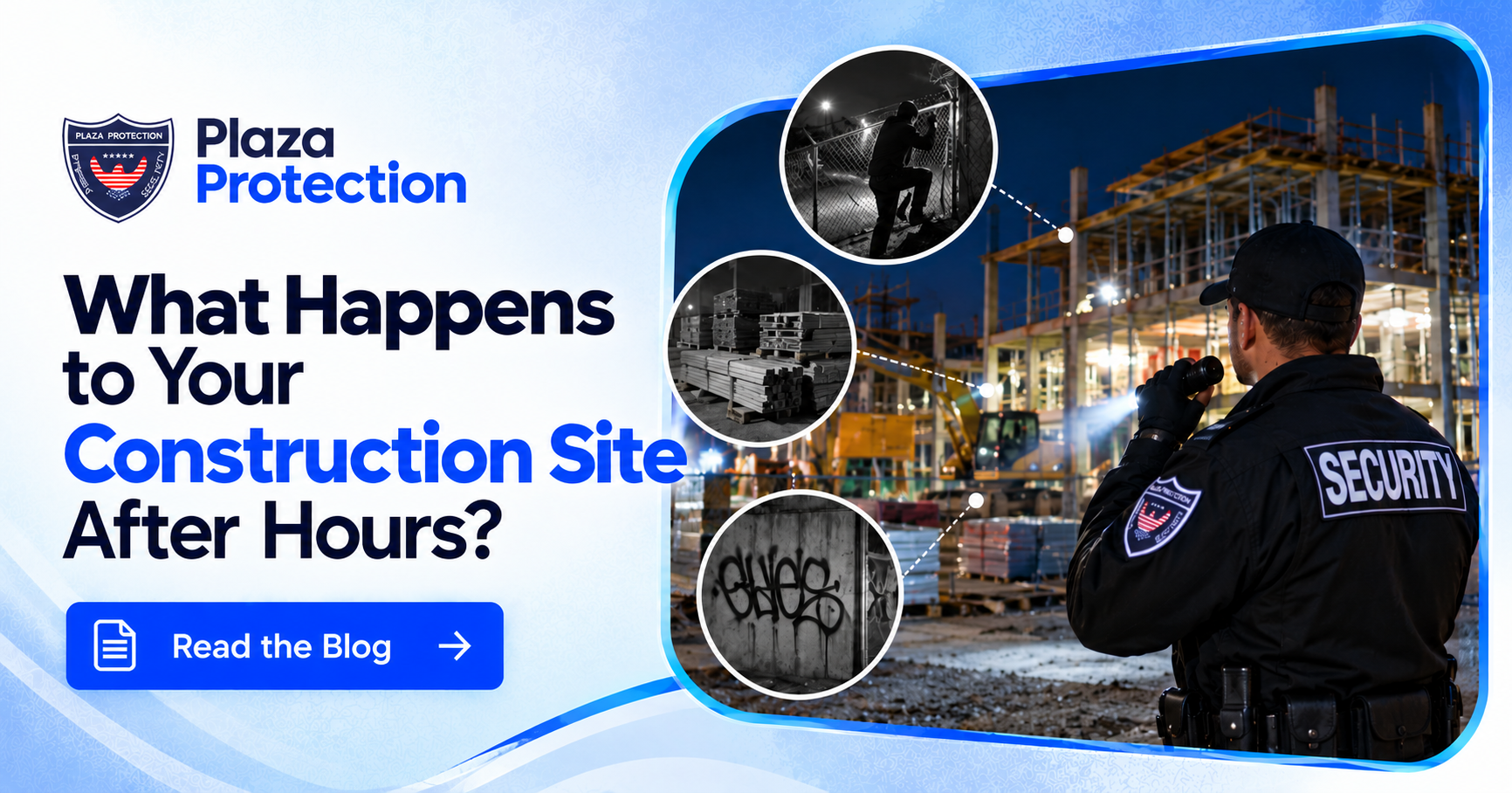
A construction site can look completely secure at 5 PM and become a very different property by midnight. Once workers leave, valuable equipment, copper wire, tools, materials and unfinished structures may sit with limited oversight. That is why construction site security after hours deserves a strategy of its own, not simply the assumption that daytime precautions will continue to work overnight.
Recent industry data reinforces the concern. TrueLook and Noonlight reported 2,639 confirmed break-ins across the construction sites included in their 2025 monitoring data, a 50% increase from 2024. More than 40% of the incidents occurred on weekends, while the highest-risk period was between 11 PM and 3 AM.
For property owners, developers and project managers, the lesson is simple: the security gap often begins when the workforce goes home.
Why Construction Sites Become More Vulnerable After Hours
Construction sites naturally create several conditions that criminals look for.
There may be valuable equipment parked in predictable locations, materials stored in temporary areas, partially completed buildings with multiple access points, temporary fencing, changing site layouts and fewer people around to notice suspicious activity.
Copper, tools, generators, equipment and building materials can be particularly attractive because they are valuable, portable or relatively easy to resell. National Equipment Register continues to warn equipment owners about theft risks around job sites, storage locations and holiday periods.
But theft is only part of the problem.
An unauthorized person entering a construction site can damage completed work, interfere with equipment, create safety hazards or expose the property owner to additional liability concerns. A small incident overnight can become a much bigger operational problem by the time the project team arrives the next morning.
My view is that construction security should be measured by what happens when nobody from the construction team is watching. That is when a security plan proves its value.
1. Start With the Perimeter, But Do Not Stop at the Fence
Fencing is important, but a fence should be treated as a boundary, not the entire security plan.
Every gate, temporary opening, pedestrian entrance and vehicle access point should be identified and reviewed before the site closes for the day. Gates should be secured, locks should be checked and access should be limited to clearly defined locations.
This matters because an unsecured gate can turn an otherwise difficult site into an easy entry point. Recent construction-site security research found unsecured gates among common factors associated with break-ins.
For larger sites, security personnel can physically inspect the perimeter and identify problems that a camera may not immediately reveal, such as damaged fencing, an open gate, missing locks or unusual activity around a storage area.
2. Make High-Value Equipment Harder to Reach
A common mistake is securing the property but leaving the most valuable assets easy to access.
At the end of each workday, equipment should be parked strategically rather than left wherever the operator last used it. Keys should be removed, storage containers should be locked and smaller high-value tools should be placed in secured areas.
Construction managers should also maintain a basic inventory of high-value equipment and materials. Record serial numbers, photographs and identifying information whenever possible.
Why?
Because security is not only about preventing something from being stolen. It is also about knowing quickly when something is missing.
If a generator disappears on Saturday night but nobody realizes it until Monday morning, valuable response time has already been lost.
3. Do Not Leave Cameras to Do a Guard’s Job
Cameras are valuable, particularly on large construction sites. They provide visibility, evidence and the ability to review activity around important areas.
But there is an important distinction:
A camera can show you what happened. A security officer can identify what is happening and respond according to the site’s procedures.
That difference matters after hours.
A layered approach can combine cameras, lighting, access control and professional security patrols. If a camera captures suspicious activity near a material storage area, an officer can investigate, document the situation and follow the property’s response procedures.
This is also where remote monitoring can strengthen an existing security plan rather than replace every physical security measure.
4. Use Patrols That Actually Cover the Site
A patrol should be more than a vehicle passing the front gate.
For a construction site, the patrol plan should reflect the property’s actual risk points. That may include gates, equipment storage, material staging areas, temporary structures, trailers, perimeter fencing, parking areas and areas that are difficult to see from the main entrance.
Randomized patrol timing can also make the site less predictable to someone watching for a routine.
Most importantly, the property owner should be able to verify that the patrol happened.
This is an area where modern security management can make a meaningful difference. Plaza Protection’s Client Portal provides real-time access to patrol activity, site tours, incident reports, visitor logs, guard schedules and GPS location tracking.
That changes the conversation from:
“Was the site checked?”
to:
“When was it checked, where did the guard go, and what did they find?”
5. Treat Access Control as a Security Issue, Not Just an Administrative Task
Construction sites have a constant flow of workers, subcontractors, delivery drivers, inspectors and visitors.
After hours, however, the standard should become much stricter.
If someone arrives when the site is closed, there should be a clear process for determining whether that person has a legitimate reason to be there. Security personnel can help control authorized access, monitor entry points and document unusual activity.
This is particularly important when a project has multiple contractors or when several phases of construction overlap.
A simple question such as “Who are you here to meet?” can become much more valuable when it is backed by a consistent access-control process.
6. Pay Special Attention to Weekends and Holidays
A construction site does not become less valuable simply because the project team is away.
In fact, weekends and holidays can create longer periods of reduced activity. Current 2026 construction-security research found that more than 40% of monitored break-ins in its dataset occurred on weekends.
That makes extended periods of inactivity worth planning for.
Before a long weekend, site management should review gates, fencing, equipment, lighting, storage areas and planned security coverage. Valuable materials should not be left exposed simply because the next scheduled workday is several days away.
7. Build a Response Plan Before Something Happens
One of the biggest weaknesses in after-hours security is not necessarily a lack of equipment. It is a lack of clarity.
What should a guard do if someone cuts the fence?
Who should be contacted if equipment is missing?
What happens when a suspicious vehicle is seen near the property?
Who receives the incident report?
When should law enforcement be contacted?
These questions should be answered before an incident occurs.
Security officers should have clear post orders and escalation procedures appropriate to the property. Project managers and property owners should also know how incidents will be documented and communicated.
Plaza Protection’s construction security approach combines access control, regular patrols, perimeter monitoring, surveillance and emergency protocols based on the specific needs of the construction site.
The Best Construction Security Plan Is Layered
There is no single measure that can eliminate every construction-site risk.
A strong after-hours strategy may combine:
Physical protection: fencing, secured gates, locks and controlled entry points.
Visibility: adequate lighting and strategically positioned cameras.
Human presence: stationed guards, foot patrols or vehicle patrols based on the site’s size and risk.
Accountability: documented patrols, incident reports, visitor logs and GPS-verified activity.
Response: clear procedures for suspicious activity, unauthorized access, theft, vandalism and emergencies.
This layered approach is more practical than relying on one technology or assuming that a fence alone will keep people out.
What Property Owners Should Ask Before Hiring Construction Security
Before choosing a security provider, ask questions that go beyond the hourly rate.
Will guards physically patrol the entire site? How will patrols be documented? Can management verify where guards have been? How are incidents reported? Who can request additional coverage? How does the provider handle access control? What happens when a security concern is identified overnight?
The answers can reveal whether you are buying a basic presence or a security operation that your management team can actually monitor.
For a construction project, visibility matters.
You should not have to wait until Monday morning to discover that something went wrong on Saturday night.
How Plaza Protection Helps Protect Construction Sites After Hours
Plaza Protection provides customized construction site security designed around the risks of the individual property. Its construction security services include access control, regular patrols, perimeter monitoring, surveillance support and proactive security measures for equipment, materials and personnel.
The difference is not simply having a guard on the property.
Plaza Protection’s Client Portal gives authorized clients real-time visibility into security operations, including GPS guard tracking, patrol activity, site tours, schedules, visitor logs and incident reporting.
For property owners and managers, that added visibility can make after-hours security much easier to manage.
You can see what happened instead of relying entirely on what you are told happened.
Final Thoughts
Construction site security after hours should not be treated as an optional layer that only becomes important after a theft or vandalism incident.
The highest-risk period may begin when the site looks quiet. Equipment is still there. Materials are still there. Gates and fences still need to be checked. And someone still needs to notice when something is not right.
The strongest approach combines physical security, controlled access, patrols, technology, documented activity and a clear response plan.
If your construction site sits unattended overnight, ask yourself one question: If someone enters the property at 2 AM tonight, who will know?
If the answer is unclear, it may be time to strengthen your after-hours security plan.
Protect Your Construction Site Before the Next After-Hours Incident
Stolen equipment, damaged materials, and unauthorized access can lead to costly delays.
Plaza Protection can help you assess your site’s vulnerabilities and build a security plan around your property’s actual needs. Request My Free Site Security Assessment


Leave A Comment