
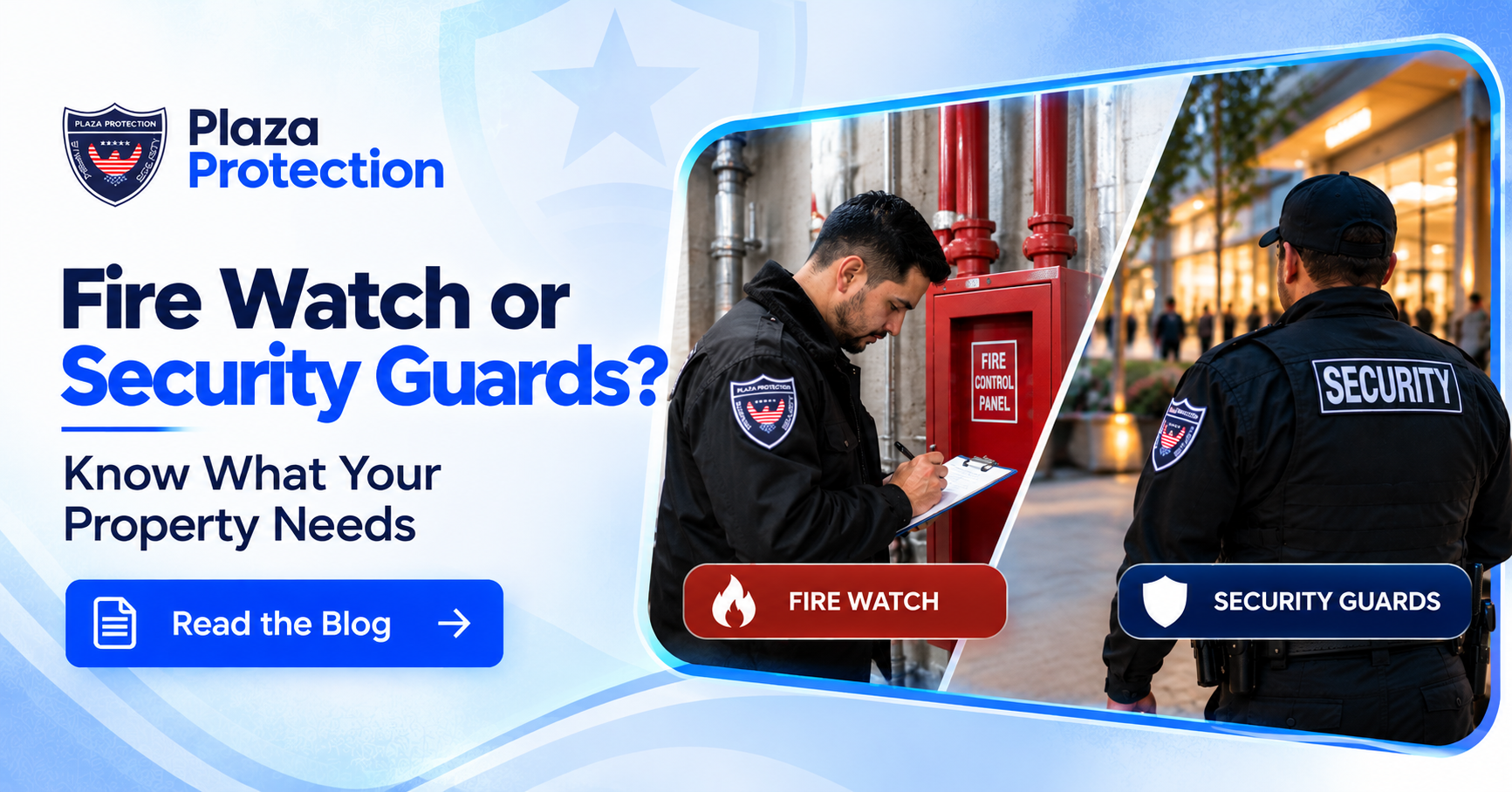
A property can have professional security guards on-site and still have a serious fire-safety gap. That is why understanding fire watch vs security guards matters. The two services may look similar because both involve trained personnel, patrols, observation, and reporting. But they exist for different reasons.
A security guard primarily protects people, property, and operations from security threats such as theft, trespassing, vandalism, unauthorized access, and disturbances. Fire watch focuses on detecting fire hazards and maintaining active surveillance when required fire protection measures are unavailable or when specific work creates elevated fire risk.
The wrong coverage can leave a critical risk unaddressed.
Fire Watch and Security Guards Have Different Jobs
Think about a commercial building undergoing sprinkler repairs. A security guard may be responsible for controlling access, protecting equipment, monitoring entrances, and preventing unauthorized activity.
A fire watch assignment has a different purpose. The assigned personnel monitor for signs of fire, identify hazards, follow the required notification procedures, and maintain the records or patrols required for the situation.
California regulations also establish specific fire-watch training and duties for applicable hot-work situations, including fire behavior, fire extinguishers, communication, evacuation procedures, and recognizing unsafe conditions.
That means a business should never assume that putting a standard security guard on-site automatically satisfies a fire-watch requirement.
When Do You Need Fire Watch?
Fire watch commonly becomes important when a required fire protection system is impaired or when work creates a heightened fire hazard.
For example, consider a construction project where welding is taking place near combustible materials. Sparks may travel into areas that are difficult to see from a fixed security post. California’s hot-work rules identify circumstances where a fire watch must be posted and state that a fire watch cannot be assigned other duties while hot work is in progress.
Fire watch may also become necessary when systems such as sprinklers, fire alarms, standpipes, fire pumps, or other required fire and life-safety systems are out of service, depending on the applicable requirements and direction of the authority having jurisdiction. HCAI’s current California guidance specifically addresses fire-watch conditions involving impaired fire-protection systems.
This is where property managers should pause before simply asking, “Can my security guard handle it?”
The better question is: “What does the fire authority, site condition, and applicable requirement actually require?”
When Do You Need Security Guards?
Security guards address a different set of problems.
A retail facility may need guards to deter theft and protect customers. An office building may need access control and after-hours patrols. A construction site may need someone watching entrances, equipment, materials, and the perimeter.
These responsibilities do not disappear because a property also needs fire watch.
For example, an empty construction site could face two separate problems overnight: a fire hazard from recent hot work and unauthorized people entering the property. One assignment may not adequately cover both, particularly when fire-watch personnel are required to have fire-watch duties as their sole responsibility.
When You May Need Both
This is the situation property managers often overlook.
Imagine a commercial building with a temporarily impaired fire alarm system during overnight hours. At the same time, the property contains expensive equipment and multiple unsecured access points.
Fire watch addresses the fire-safety risk. Security coverage addresses unauthorized access, theft, vandalism, and general property protection.
Using both services can therefore make more sense than asking one person to divide attention between unrelated responsibilities.
The key is to define the assignments clearly rather than assuming that “one guard can do everything.”
What About Overnight Coverage?
Overnight hours create another challenge. A property becomes quieter, fewer employees are available to notice unusual conditions, and management may not be nearby to make decisions.
That is exactly when delayed detection can turn a manageable problem into an expensive incident.
A fire-watch officer needs to actively monitor the designated areas and follow the applicable fire-watch procedures. A security officer needs to focus on the property’s security concerns. Both require clear instructions, communication procedures, and documented activity.
How to Decide Which Service You Need
Before hiring coverage, property managers should answer four questions:
What risk are we trying to control?
Fire hazards, impaired fire systems, theft, unauthorized access, vandalism, or several risks at once?
Why is the risk present?
Construction, hot work, maintenance, system failure, after-hours operations, or an ongoing security concern?
What does the applicable authority require?
Fire-watch requirements can vary based on the property and situation, so confirm requirements with the appropriate fire authority or responsible code official.
Can the assigned personnel perform the required duties without competing responsibilities?
This matters particularly when a fire watch is required for hot work or an impaired fire-protection system.
How Plaza Protection Helps You Choose the Right Coverage
At Plaza Protection, we do not believe every property needs the same security package.
Our team provides fire watch and security guard services for commercial properties, construction sites, healthcare facilities, shopping centers, and other environments with changing security and safety needs. Our fire-watch service includes continuous monitoring, hazard detection, emergency response, routine inspections, and detailed reporting.
We can also provide traditional security coverage when the primary concern involves access control, theft prevention, trespassing, property protection, or after-hours security.
And when a property faces both types of risk, the solution may involve both services with clearly defined responsibilities.
That distinction matters. Instead of selling more guards simply because more coverage sounds better, the goal should be to match the personnel, assignment, and coverage to the actual risk.
Final Thoughts
Understanding fire watch vs security guards comes down to one simple principle: different risks require different responsibilities.
Fire watch focuses on detecting and responding to fire hazards when specific conditions call for it. Security guards focus on protecting people, property, and operations from security threats. In some situations, you need one. In others, you need both.
The smartest approach is not to guess based on the uniform a guard wears. Assess the situation, confirm applicable requirements, define the assignment, and make sure the people you hire are prepared for the responsibilities they are expected to perform.
Does Your Property Need Fire Watch, Security, or Both?
Don’t wait until a fire-system outage, construction hazard, or overnight security incident exposes a coverage gap.
Not sure whether your property needs fire watch, security guards, or both? Contact Plaza Protection today to discuss your property’s needs, explore suitable coverage options, or request a free quote for a coverage plan tailored to your property.

Leave A Comment