
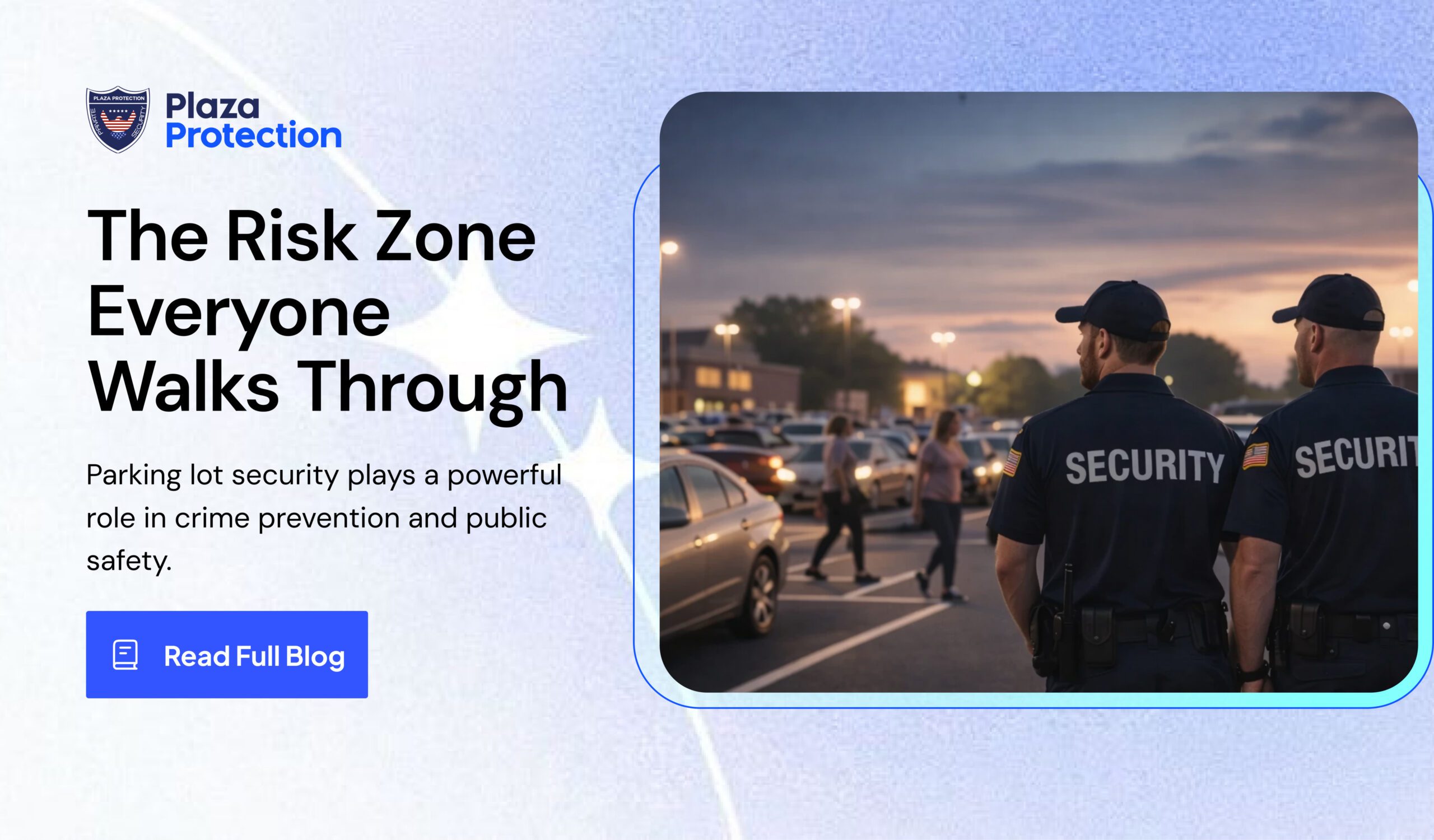
Parking lot security is often treated as a secondary concern.
Businesses may invest in alarms, access control, cameras, and security at the building entrance while overlooking the place where employees, customers, tenants, vendors, and visitors often spend their first and last few minutes on the property: the parking lot.
That creates a security gap.
Parking areas can expose businesses to vehicle theft, break-ins, vandalism, personal safety threats, unauthorized access, accidents, poor visibility, fire hazards, and liability concerns.
A secure parking lot does more than deter crime. It helps businesses create a safer environment, protect property, support employees and customers, reduce preventable risks, and respond more effectively when incidents occur.
This guide explains why parking lot security matters, the major risks businesses should address, the most effective prevention strategies, and how professional security services can strengthen an overall parking-area safety plan.
Why Parking Lot Security Matters to Businesses
A parking lot is part of your business property—not a separate space outside your security strategy.
People may use it:
- Early in the morning
- Late at night
- During shift changes
- During busy customer periods
- During weekends and holidays
- During deliveries
- During special events
At certain times, a parking lot can become relatively quiet and difficult to supervise.
Large lots may also contain numerous access points, isolated areas, blind spots, parked vehicles, landscaping, structures, and pedestrian pathways.
These conditions can increase the opportunity for both criminal activity and accidents.
A well-maintained and actively monitored parking area can help businesses:
- Protect employees and visitors
- Reduce opportunities for theft and vandalism
- Improve visibility after dark
- Identify hazards earlier
- Strengthen emergency response
- Protect vehicles and property
- Support a positive customer experience
- Demonstrate proactive risk management
Horst Insurance similarly describes parking lot safety as an important part of business risk management because it can affect injuries, liability, customer experience, employee satisfaction, and crime exposure.
Parking Lot Security vs. Parking Lot Safety
These terms are closely related, but they aren’t exactly the same.
Parking Lot Security
Security focuses primarily on intentional threats such as:
- Theft
- Vehicle break-ins
- Vandalism
- Assault
- Robbery
- Unauthorized access
- Trespassing
- Suspicious activity
Parking Lot Safety
Safety covers both accidental and environmental hazards, including:
- Vehicle collisions
- Slip-and-fall hazards
- Potholes
- Poor drainage
- Ice and snow
- Poor traffic flow
- Blocked pedestrian paths
- Fire hazards
- Structural damage
An effective business strategy should address both.
A parking lot can be free of criminal activity and still be unsafe because of poor lighting, damaged pavement, blocked walkways, or traffic hazards.
10 Major Parking Lot Risks Businesses Should Address
1. Vehicle Break-Ins and Theft
Vehicles left unattended can attract criminals looking for valuables or opportunities to steal the vehicle itself.
Common targets may include:
- Electronics
- Laptops
- Tools
- Bags
- Packages
- Cash
- Personal documents
- Other valuables
The risk can increase when parking areas are poorly lit, isolated, or rarely monitored.
How businesses can reduce the risk
Consider:
- Security patrols
- CCTV coverage
- Improved lighting
- Clear sightlines
- Regular inspections
- Monitoring entrances and exits
- Appropriate security signage
- Prompt investigation of recurring incidents
Businesses should also encourage employees and visitors not to leave valuable items visible inside vehicles.
2. Personal Safety Threats
For many businesses, protecting people should be the first priority.
Employees may leave late at night. Customers may walk across a large lot alone. Healthcare, hospitality, retail, manufacturing, and commercial properties may have people arriving or leaving outside normal business hours.
Potential threats include:
- Assault
- Robbery
- Harassment
- Carjacking
- Intimidation
- Suspicious individuals approaching pedestrians
- Other criminal behavior
The perceived safety of the walk from the building to the vehicle matters.
Improve pedestrian safety by:
- Maintaining good lighting
- Keeping pedestrian routes visible
- Removing unnecessary obstructions
- Monitoring isolated areas
- Providing emergency communication options where appropriate
- Conducting regular patrols
- Training security personnel in appropriate response procedures
A visible security presence can also provide reassurance to employees and visitors.
3. Vandalism and Property Damage
Parking lot vandalism may include damage to:
- Vehicles
- Gates
- Barriers
- Cameras
- Lights
- Signs
- Ticketing equipment
- Building entrances
- Property fixtures
Repeated vandalism can create direct repair costs and indicate that a larger security weakness exists.
For example, repeated damage near one entrance may suggest:
- Poor camera coverage
- Inadequate lighting
- Weak access control
- Insufficient patrols
- A predictable security gap
Instead of treating every incident independently, businesses should look for patterns.
4. Poor Lighting
Lighting is one of the most important elements of a parking lot security strategy.
A parking lot can technically have lighting while still having poorly illuminated areas.
Common problems include:
- Burned-out fixtures
- Dark corners
- Uneven illumination
- Obstructed lights
- Poorly lit walkways
- Dark stairwells
- Shadows around buildings and parked vehicles
Good lighting helps employees and visitors see where they are going and helps guards, cameras, and other security systems maintain better visibility.
Conduct nighttime inspections
Don’t evaluate parking lot lighting only during the day.
Walk the property after dark.
Look for:
- Dark zones
- Poorly illuminated entrances
- Areas hidden behind landscaping
- Shadows near parked vehicles
- Poorly lit pedestrian routes
- Lighting failures around perimeter areas
A lighting audit should be part of the overall parking security assessment.
5. Blind Spots and Obstructed Visibility
Even with cameras and lighting, businesses can have areas where visibility is poor.
Blind spots may be caused by:
- Trees
- Shrubs
- Walls
- Parking structures
- Large vehicles
- Utility equipment
- Building corners
- Pillars
- Poor camera placement
Landscaping should therefore be considered part of security planning.
A camera that provides excellent coverage during installation can become less effective when vegetation grows or site conditions change.
Businesses should regularly review:
- CCTV coverage
- Landscaping
- Lighting
- Parking layouts
- Pedestrian routes
- Areas hidden from natural observation
6. Unauthorized Access and Suspicious Activity
Parking areas can provide an indirect route into the building.
Someone may enter the parking lot first and then attempt to gain access to:
- Side entrances
- Employee doors
- Loading areas
- Garages
- Restricted areas
- Service entrances
Businesses should pay attention to unusual behavior rather than making assumptions based on appearance.
Examples of behavior that may warrant attention include:
- Attempted access to restricted areas
- Tampering with doors or gates
- Repeated loitering in prohibited areas
- Vehicles repeatedly circling the property
- Someone attempting to conceal their activity
- Unauthorized entry after closing
Security personnel should follow established observation, communication, and escalation procedures.
7. Vehicle and Pedestrian Accidents
Parking lot safety also involves preventing accidental injuries.
Common hazards include:
- Poorly marked crosswalks
- Confusing traffic flow
- Excessive vehicle speed
- Poor visibility
- Potholes
- Uneven pavement
- Damaged curbs
- Blocked walkways
- Poorly marked spaces
- Vehicles and pedestrians sharing the same paths
These issues can result in:
- Vehicle collisions
- Pedestrian injuries
- Property damage
- Employee incidents
- Customer complaints
- Potential liability exposure
Horst Insurance highlights collisions, trips and falls, weather-related hazards, and maintenance issues as important parking-lot safety concerns for businesses.
8. Weather and Environmental Hazards
Parking lot risks change with the weather.
Heavy rain can cause:
- Standing water
- Flooding
- Slippery surfaces
- Reduced visibility
Cold weather can create:
- Ice
- Snow
- Frozen surfaces
- Reduced traction
Other environmental concerns may include:
- Oil spills
- Fuel leaks
- Chemical spills
- Poor drainage
- Fallen branches
- Debris
Businesses should have procedures for identifying and reporting these hazards quickly.
9. Fire and Emergency Risks
Parking lots and garages may contain vehicles, fuel, electrical systems, charging equipment, and other potential fire sources.
Possible risks include:
- Vehicle fires
- Electrical problems
- Fuel leaks
- Battery-related incidents
- Arson
- Blocked emergency access
Enclosed parking structures can create additional concerns related to smoke, ventilation, and evacuation.
Businesses should ensure:
- Emergency routes remain accessible
- Fire protection equipment is maintained
- Exits are clearly marked
- Security personnel know emergency procedures
- Hazards are reported promptly
- Appropriate emergency communication is available
Security guards should respond within their training and established emergency procedures.
10. Parking Garage and Structural Risks
Multi-level garages can introduce additional vulnerabilities.
These may include:
- Isolated floors
- Stairwells
- Elevators
- Poorly lit corners
- Blind spots
- Damaged barriers
- Water intrusion
- Structural deterioration
- Clearance hazards
Security personnel may identify visible problems during patrols, but structural concerns should be evaluated by qualified professionals.
Security patrols complement—not replace—engineering, maintenance, and building inspections.
The Business Impact of Poor Parking Lot Security
Parking incidents don’t stop at the parking spaces.
A serious incident can affect multiple parts of a business.
Financial impact
Businesses may face:
- Property damage
- Repair expenses
- Operational disruption
- Insurance claims
- Replacement costs
Employee impact
Employees may feel less safe coming to or leaving work, particularly during evening or overnight shifts.
Customer impact
Customers may reconsider visiting a location where they repeatedly experience unsafe conditions.
Reputation impact
People may associate visible security problems with poor property management.
Operational impact
A damaged gate, unsafe entrance, theft, or emergency can disrupt normal operations.
This is why parking lot security should be viewed as business continuity and risk management, not simply crime prevention.
How Parking Lot Security Supports Customer Experience
Security and customer experience aren’t opposites.
A parking lot should feel secure without feeling intimidating.
A well-managed security environment can provide:
- Clear traffic flow
- Visible security presence
- Well-maintained lighting
- Easy-to-understand signage
- Safe pedestrian movement
- Quick assistance when problems occur
The objective is to create an environment where customers notice the sense of safety, rather than constantly noticing security equipment.
8 Effective Parking Lot Security Measures
1. Security Patrols
Foot and vehicle patrols provide a visible security presence and allow personnel to inspect areas that cameras may not fully cover.
Patrols can help identify:
- Suspicious activity
- Broken lights
- Damaged property
- Unsecured access points
- Safety hazards
- Unusual vehicles
For larger properties, mobile patrols can cover multiple sections efficiently.
2. CCTV and Video Monitoring
Surveillance cameras can improve visibility and provide recorded evidence when incidents occur.
Strategic camera locations may include:
- Entrances
- Exits
- Pedestrian pathways
- Garage entrances
- High-risk areas
- Loading zones
- Building access points
Cameras should be reviewed periodically to ensure that landscaping, construction, parking changes, or lighting conditions haven’t created new blind spots.
3. Access Control
Access control can reduce unauthorized entry to restricted areas.
Depending on the property, this might include:
- Gates
- Keycards
- Vehicle credentials
- Controlled garage access
- Visitor management
- Restricted-area controls
Not every parking lot needs controlled vehicle entry.
The appropriate approach depends on risk, traffic volume, business operations, and the property’s design.
4. Emergency Communication
People should have a way to request assistance when an emergency occurs.
Depending on the property, options may include:
- Emergency phones
- Panic buttons
- Help stations
- Intercoms
- Mobile communication
- Security personnel
Horst Insurance specifically identifies panic buttons and emergency phones as possible parking-lot safety measures.
5. Better Lighting
Lighting should cover:
- Parking spaces
- Pedestrian routes
- Entrances
- Exits
- Stairwells
- Elevators
- Garage levels
- Perimeters
Businesses should also establish a process for reporting and repairing lighting failures quickly.
6. Clear Signage and Traffic Management
Security also includes reducing confusion.
Appropriate signage can clarify:
- Parking rules
- Speed limits
- Pedestrian crossings
- Restricted areas
- Emergency exits
- Accessible spaces
- Vehicle entrances and exits
- After-hours procedures
Road markings should remain visible and property rules should be easy to understand.
7. Landscaping and Visibility Management
Landscaping should support—not undermine—security.
Regularly review:
- Shrubs near walkways
- Trees blocking lights
- Vegetation around cameras
- Areas where people can hide
- Obstructions near entrances
Maintaining sightlines can improve the effectiveness of both human and technological security.
8. Regular Security Inspections
A parking lot security program should be reviewed regularly.
Inspect:
- Lighting
- Cameras
- Gates
- Locks
- Signs
- Pavement
- Drainage
- Pedestrian paths
- Emergency equipment
- High-risk areas
Don’t wait for an incident to reveal a vulnerability.
Why Parking Lot Patrols Matter
Technology provides valuable visibility, but physical patrols add another layer of protection.
A security officer can physically inspect conditions and make real-time decisions.
During a patrol, an officer may identify:
- A broken light
- A person attempting unauthorized access
- A damaged gate
- A suspicious vehicle
- An open door
- A safety hazard
- An abandoned item
- Signs of vehicle tampering
That information can then be communicated and documented according to site procedures.
Safex Security similarly emphasizes visible guards, mobile patrol, rapid response, incident reporting, and technology-supported monitoring as components of a broader security strategy.
Foot Patrol vs. Vehicle Patrol for Parking Lots
Businesses often ask whether they need a stationary security guard, foot patrol, or mobile patrol.
The answer depends on the property.
Foot patrols work well when:
- Pedestrian areas need close inspection
- The property has stairwells or garages
- Employees need visible security support
- Access points require frequent checks
- The lot is relatively compact
Vehicle patrols work well when:
- The property covers a large area
- There are multiple parking lots
- A large perimeter must be covered
- Multiple buildings share the parking area
- The site requires mobile response
A combination can provide broader coverage
For larger or higher-risk properties, a security plan may combine:
Fixed security presence + foot patrols + vehicle patrols + CCTV
The exact mix should come from a site-specific security assessment.
Modern Parking Lot Security: Combining Guards and Technology
Parking security has evolved beyond simply putting a guard at an entrance.
Modern security programs can combine human security officers with technology such as:
- CCTV
- Remote video monitoring
- Access control
- Mobile guard reporting
- GPS-enabled patrol tracking
- Digital incident reports
- Automated notifications
- Emergency communication systems
- Analytics-assisted surveillance
The goal is not to use technology for its own sake.
The goal is to create a connected security system where information reaches the right people quickly.
For example:
Camera identifies unusual activity → security team receives information → guard investigates → incident is documented → management is notified.
That is more useful than simply storing hours of camera footage.
AI and Smart Surveillance in Parking Lots
AI-assisted video analytics are increasingly being used to help identify predefined events or activity patterns.
Depending on the system, applications may include:
- Monitoring restricted areas
- Detecting movement after hours
- Identifying certain vehicle activity
- Supporting rapid footage review
- Generating alerts for defined events
However, businesses should not treat AI as a replacement for security personnel.
Technology can generate alerts, but trained personnel may still need to:
- Assess the situation
- Determine whether an actual threat exists
- Communicate with stakeholders
- Respond appropriately
- Document the event
A practical model is:
Technology detects. People decide. Security responds.
Digital Reporting Makes Parking Security More Accountable
A modern parking security program should also produce useful records.
Digital reporting can document:
- Patrols
- Incidents
- Suspicious activity
- Lighting problems
- Property damage
- Safety hazards
- Access issues
- Photos
- Corrective actions
For property managers, that creates greater visibility into what is happening on the ground.
Instead of hearing:
“The lot was checked.”
management can have documented records showing:
- When it was checked
- Who checked it
- What was observed
- Whether problems were found
- What action was taken
That information can also help identify recurring vulnerabilities.
Conduct a Parking Lot Security Risk Assessment
A security assessment should examine more than crime statistics.
Review the entire environment.
People
Who uses the parking lot?
- Employees
- Customers
- Residents
- Visitors
- Contractors
- Vendors
Time
When is the property most vulnerable?
- Early morning
- Evening
- Overnight
- Weekends
- Holidays
- Shift changes
Physical environment
Look at:
- Lighting
- Landscaping
- Buildings
- Entrances
- Exit routes
- Parking structures
- Pedestrian paths
Security systems
Review:
- CCTV
- Access control
- Emergency communication
- Alarms
- Patrol procedures
History
Examine:
- Previous incidents
- Complaints
- Vehicle break-ins
- Vandalism
- Safety incidents
- Lighting failures
Parking Lot Security Assessment Questions
Ask these questions during an inspection:
Visibility
- Are all areas adequately illuminated?
- Are there dark corners?
- Can people see clearly between parking spaces?
- Are cameras blocked or poorly positioned?
Access
- How many entrances and exits exist?
- Are restricted areas controlled?
- Can unauthorized individuals easily enter?
Personal Safety
- Are pedestrian paths visible?
- Are there isolated areas?
- Can employees safely reach their vehicles after dark?
Crime Prevention
- Have theft or vandalism incidents occurred?
- Are there recurring problem locations?
- Is patrol coverage sufficient?
Safety
- Are there potholes or uneven surfaces?
- Are emergency routes clear?
- Is drainage adequate?
- Are signs and markings visible?
Response
- Who receives security alerts?
- How quickly can a guard respond?
- How are incidents escalated?
- How are incidents documented?
Parking Lot Security Checklist for Businesses
Use this as a starting point for your next review.
Lighting
- Parking areas are adequately illuminated
- Entrances and exits are well lit
- Pedestrian paths are visible
- Stairwells and garages are illuminated
- Burned-out lights are reported promptly
Surveillance
- Cameras cover key areas
- Camera views are unobstructed
- High-risk areas are monitored
- Equipment is functioning
- Blind spots are reviewed regularly
Access
- Vehicle entrances are monitored where appropriate
- Restricted areas are controlled
- Gates function correctly
- Unauthorized access is investigated
Patrols
- Patrol routes are defined
- High-risk areas receive appropriate attention
- After-hours patrols are scheduled where required
- Patrol activity is documented
- Issues are escalated appropriately
Safety
- Walkways are clear
- Potholes are reported
- Spills are addressed
- Traffic markings are visible
- Emergency routes are accessible
- Drainage is functioning
Incident Management
- Incidents are documented
- Photos are captured when appropriate
- Management is notified according to procedure
- Serious incidents are escalated
- Recurring issues are reviewed
How Businesses Can Make Parking Lots Safer
A practical strategy is to think in layers.
Layer 1: Design
Create clear traffic and pedestrian movement.
Layer 2: Visibility
Improve lighting and eliminate unnecessary blind spots.
Layer 3: Technology
Use CCTV, access control, communication systems, and other appropriate tools.
Layer 4: Human Presence
Use security guards and patrols where the risk assessment justifies them.
Layer 5: Response
Create clear procedures for emergencies, suspicious activity, accidents, and other incidents.
Layer 6: Reporting
Document patrols, incidents, hazards, and corrective actions.
Layer 7: Review
Regularly reassess the property as its use, staffing, traffic, and risk profile change.
This layered approach is more resilient than depending on one security measure.
How Plaza Protection Helps Businesses Improve Parking Lot Safety
Plaza Protection provides customized security services designed around the unique risks of commercial properties and parking areas.
Depending on the property and its requirements, services can include:
Security Guards
Trained security personnel provide a visible presence, monitor activity, conduct inspections, assist with access control, and respond to security concerns.
Foot Patrols
Officers can inspect parking areas, walkways, entrances, stairwells, garages, and other vulnerable locations.
Vehicle Patrols
Mobile patrols help cover larger properties, multiple parking areas, and extended perimeters.
Access Control
Security personnel can monitor designated entrances, visitors, vendors, and vehicles according to property procedures.
Incident Response
Officers can respond to security concerns and follow established escalation procedures.
Digital Reporting
Patrol activity, incidents, suspicious activity, and property concerns can be documented for management visibility.
Surveillance Support
Security personnel can work alongside cameras and other technology to create a more comprehensive parking-area security program.
Customized Security Planning
No two parking lots have exactly the same risks.
A shopping center, office complex, apartment community, healthcare facility, industrial property, and construction site can each require a different combination of patrols, access control, surveillance, and security personnel.
Plaza Protection can build a security approach around factors such as:
- Property layout
- Hours of operation
- Traffic volume
- Crime exposure
- Previous incidents
- Number of access points
- Parking area size
- Client requirements
Parking Lot Security for Different Business Types
Retail and Shopping Centers
Key concerns often include:
- Customer safety
- Vehicle break-ins
- Theft
- Evening activity
- Pedestrian safety
- Large parking areas
Office Buildings
Important considerations include:
- Employee safety
- Early-morning arrivals
- After-hours departures
- Visitor access
- Parking structures
Residential Communities
Focus areas may include:
- Resident safety
- Vehicle theft
- Garage access
- Unauthorized visitors
- Overnight activity
Healthcare Facilities
Parking areas may operate around the clock, creating the need for:
- Staff safety
- Visitor management
- Emergency access
- Overnight patrols
- Clear pedestrian routes
Industrial and Warehouse Sites
Security may need to focus on:
- Fleet vehicles
- Loading areas
- Equipment
- Large perimeters
- After-hours access
7 Signs Your Business Needs Stronger Parking Lot Security
Your current strategy may need improvement if:
1. Vehicle break-ins are increasing
Repeated incidents indicate that existing deterrence or monitoring may be insufficient.
2. Employees don’t feel safe after dark
Employee concerns should be treated as meaningful security feedback.
3. You have large areas without active monitoring
Unmonitored areas can create avoidable vulnerabilities.
4. Lighting problems remain unresolved
A recurring lighting problem can become a recurring security problem.
5. You can’t verify patrol activity
If management has no reliable record of patrols, accountability may be limited.
6. Security incidents are discovered after the fact
This may indicate inadequate real-time visibility or response.
7. Your security plan hasn’t been reviewed recently
Parking lots change.
So should the security assessment.
Final Thoughts
Parking lot security is not simply about preventing someone from breaking into a vehicle.
It is about protecting people, vehicles, property, operations, and the reputation of the business.
An effective strategy considers the full environment:
Crime + personal safety + lighting + visibility + access + traffic + maintenance + emergency response + security patrols + technology + reporting.
The most effective parking security programs are proactive.
They identify vulnerabilities before incidents happen, combine physical security with appropriate technology, maintain clear reporting procedures, and continuously adjust to changing conditions.
A secure parking lot can help employees feel safer, improve the customer experience, reduce preventable risks, and give property managers greater confidence that their premises are being actively monitored.
Don’t wait for a theft, assault, accident, or major security incident to reveal weaknesses in your parking area.
Assess the risks. Strengthen the weak points. Protect the people who use your property every day.
Plaza Protection can help businesses develop a customized parking lot security strategy built around their property’s specific risks and operating needs.
Request a Free Security Risk Assessment today.

Leave A Comment