
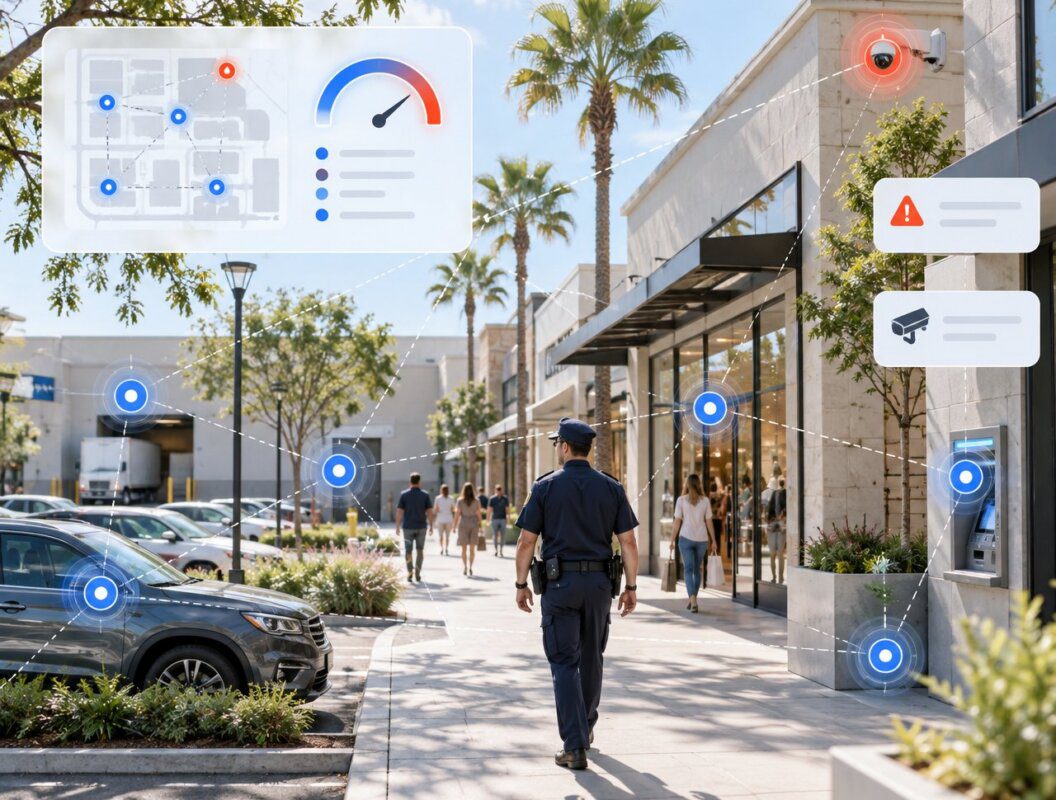
A shopping center can look busy, well-lit, and secure while still having serious vulnerabilities. Shopping center security is rarely about one obvious weak point. Bigger problems often sit between tenants, parking areas, technology, and after-hours operations. In my experience, property managers often discover these gaps only after an incident forces them to look closer.
Here are seven security risks worth putting under the microscope before they become expensive problems.
1. Too Many Ways In and Out
Multiple entrances make shopping centers convenient for customers, but they also create more opportunities for unauthorized access. Parking structures, loading docks, service corridors, stairwells, and rooftop access points may receive far less attention than main entrances.
The practical question is not simply, “Are the doors locked?” It is, “Who can reach these areas, and what happens after normal business hours?”
Managers should regularly review access permissions, inspect secondary entrances, and include vulnerable areas in patrol routes.
2. Parking Lots Become a Security Blind Spot
Customers often spend several minutes walking through a parking lot before entering a store. That makes parking areas part of the customer experience, not an area security teams can ignore.
Poor lighting, isolated spaces, damaged gates, blocked sightlines, and limited patrol visibility can create opportunities for theft, vandalism, and other incidents.
A useful quarterly review should include lighting, cameras, emergency phones, pedestrian routes, and patrol coverage.
3. Crowds Can Change the Risk Picture Quickly
Shopping centers deal with large numbers of people arriving and leaving throughout the day. Holiday shopping, promotions, concerts, community events, and unexpected gatherings can quickly change a property’s security needs.
Managers should create temporary security plans for predictable surges rather than relying on normal staffing levels.
That may mean adding visible shopping center security guards, increasing patrol frequency, establishing communication points, or coordinating coverage with tenants.
4. Organized Retail Crime Does Not Stay Inside One Store
Organized retail crime creates a different challenge from ordinary shoplifting. Multiple individuals may target several businesses, use distraction tactics, or return repeatedly to the same property.
One overlooked problem is the gap between individual tenants. A security team may know something happened at Store A while Store B has no idea a similar incident occurred nearby.
Sharing appropriate information between tenants and property management can help identify patterns sooner. Security should therefore be treated as a property-wide strategy, not something every tenant manages independently.
5. Cameras Do Not Automatically Mean Good Coverage
Many shopping centers have plenty of cameras, but that does not guarantee effective surveillance.
A camera may be pointed in the wrong direction, produce poor footage at night, or leave important areas uncovered. Older systems may also make footage difficult to locate or share quickly.
Property managers should periodically test camera views and ask:
“If something happened here tonight, would we actually capture it clearly?”
Technology should support security officers, not replace property inspections and human observation.
6. Security Staffing Can Look Good on Paper
A security schedule might show enough hours while still leaving important areas uncovered.
The real issue is how officers spend those hours. Are guards positioned where they are most needed? Are patrol routes predictable? Does coverage increase during peak periods? What happens when an officer calls out?
Good shopping center security services should be based on risk and activity, not simply the number of guard hours purchased.
Managers should regularly review patrol routes, incident patterns, peak traffic periods, response expectations, and backup coverage.
7. Guard Training and Communication Can Make or Break a Response
Even a well-designed security plan can fail when officers do not understand the property.
Shopping centers constantly deal with changing tenants, contractors, events, deliveries, and customer activity. Guards need clear site instructions and regular communication to stay effective.
Training should cover emergency response, communication, observation, incident reporting, customer interaction, and site-specific procedures.
High turnover makes this even more important. Every new officer should understand the property rather than simply receiving a uniform and post assignment.
What Should Property Managers Do Next?
A useful security review does not need to be complicated. Walk the property from a customer’s perspective, then walk it again from a security officer’s perspective.
Look for:
- Places where people can enter unnoticed
- Areas that become isolated after closing
- Parking or loading zones with limited visibility
- Recurring incidents or tenant complaints
- Camera blind spots
- Gaps between tenant and property security procedures
Then compare those findings with your current patrol schedule and security coverage.
The goal is not to make the property feel like a fortress. It is to make security visible, consistent, and difficult to predict around vulnerable areas.
How Plaza Protection Can Help
Plaza Protection provides customized security solutions for shopping centers and commercial properties, including professional security guards, vehicle patrols, foot patrols, remote surveillance, and detailed incident reporting.
Our team can help property managers identify vulnerable areas, improve patrol coverage, strengthen visibility, and build a security approach around how the property actually operates.
Final Thoughts
Effective shopping center security means looking beyond the obvious. Parking lots, secondary entrances, tenant communication, camera coverage, staffing, and guard training can all create gaps that are easy to overlook until something goes wrong.
The strongest security plan is not necessarily the one with the most guards or technology. It is the one designed around how people actually use the property and where risks are most likely to appear.
Is Your Shopping Center More Vulnerable Than You Think?
Don’t wait for an incident to reveal a security gap.
Contact Plaza Protection today to schedule a security consultation. Our team can assess your property’s vulnerabilities and recommend a practical security strategy built around your tenants, customers, and operational needs.
Request a free quote: Get a custom security solution built around your budget and layout.